Elon Musk, money and the AI singularity: what may come after fiat?
If intelligence becomes abundant, the energy that powers it may become the real economic prize.

Capital Park · Singapore
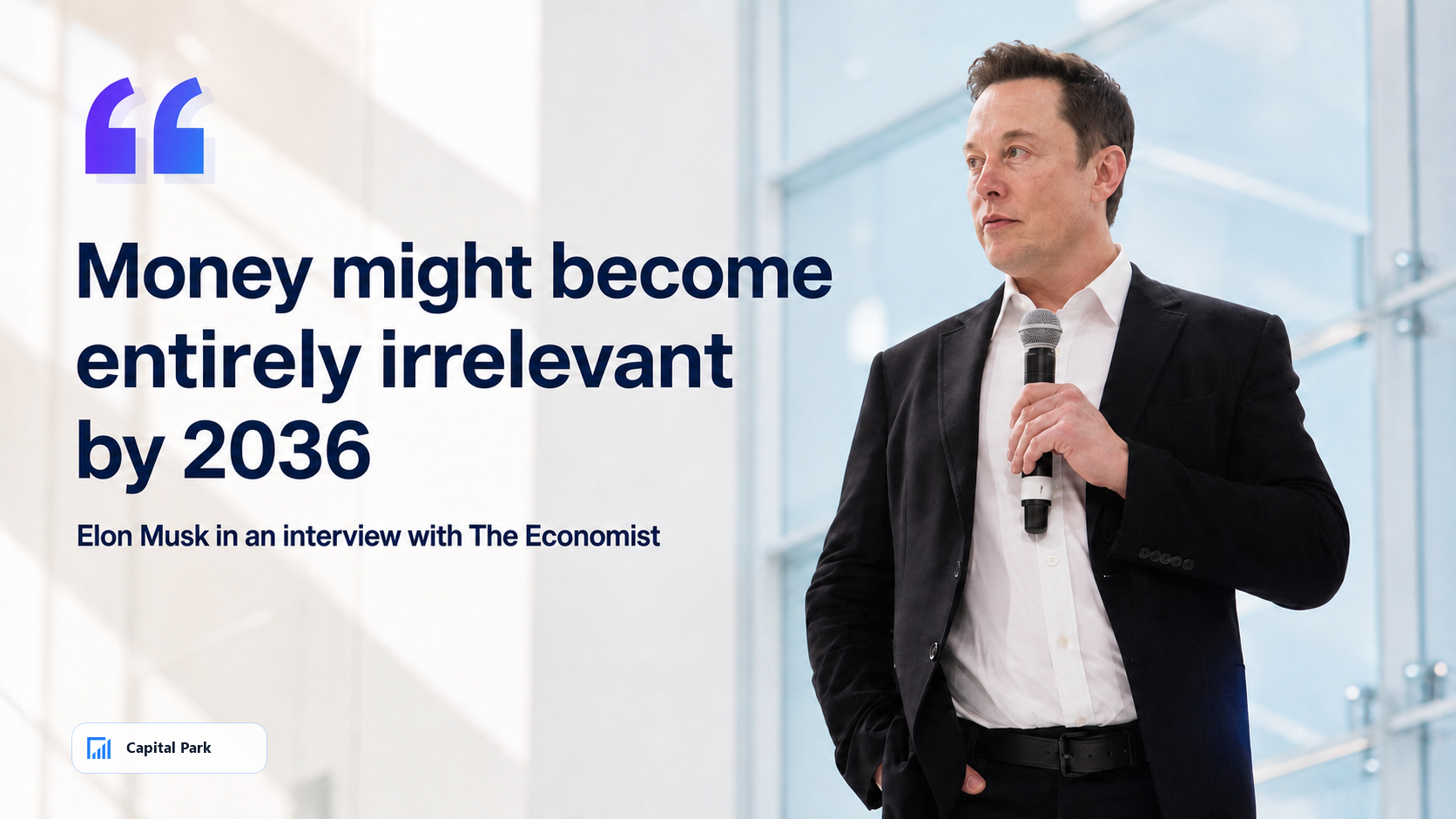
In a recent 90-minute interview with The Economist editor-in-chief Zanny Minton Beddoes, Elon Musk offered a sweeping forecast for the next decade. The conversation, filmed at Tesla’s Texas factory, ranged from artificial intelligence and humanoid robots to jobs, China, SpaceX, geopolitics, government spending and the power of social media.
The central idea was bigger than any one company. Musk believes the world is moving toward a point at which machine intelligence no longer merely assists human intelligence—it surpasses it. From there, he sees AI moving out of the digital realm and into the physical economy through robots capable of producing goods and delivering services at enormous scale.
It is a bold vision. It also raises a question investors should not ignore: if intelligence becomes abundant, what remains scarce?
The AI singularity—and a five-year clock
At about 1:10 in the interview, Musk predicts that AI may exceed the combined intelligence of humanity in roughly five years. His claim is not simply that a model will outperform an individual expert on a test. He is describing a world in which the total capability of digital intelligence becomes greater than the sum of human cognitive capability.
That is what many people would recognize as an AI singularity: once machine intelligence moves decisively beyond human intelligence, the pace and direction of progress become much harder for people to predict—or control.
Musk is unusually optimistic about the destination, even as he acknowledges the risks. He argues that the most likely outcome is an “age of amazing abundance.” In his view, AI will first master tasks performed on computers and phones. Humanoid robots will then serve as the physical end effectors of that intelligence, allowing AI to manipulate atoms, operate machinery, build products and perform services in the real world.
Put digital intelligence and physical robotics together at sufficient scale, Musk argues, and the result is a “quasi-infinite economy”: machine output expands so dramatically that production, rather than human labor, ceases to be the limiting factor.
When abundance challenges money
Around 4:38, the discussion turns from technological capability to a practical economic question: if Musk’s companies create this future, how will they make money?
His answer is intentionally provocative: “money won’t matter in 2036.”
The reasoning is straightforward. People want money because it gives them access to food, housing, transportation, entertainment and other goods and services. If AI and robots can produce more than people could reasonably consume, Musk asks, what purpose would money still serve?
Beddoes presses him on the transition. Robots must first be built, energy must be supplied, and people whose jobs are displaced still need a way to participate in the economy. Musk expects that road to be bumpy. He suggests a form of universal high income and argues that governments could issue checks without causing inflation as long as the supply of goods and services grows faster than the money supply. In his scenario, deflation—not inflation—becomes the greater concern.
What the rest of the interview reveals
Musk says digital jobs are likely to be disrupted first, with physical work following as robotics improves. He compares future human work to gardening: something people may choose to do for meaning or enjoyment rather than something required for survival. He also argues that humans may no longer be meaningfully in control once AI becomes vastly more intelligent than we are, making values, truth-seeking behavior and coordination among leading AI labs and governments central safety issues.
The discussion then widens. Musk describes electricity and cooling as critical constraints on AI expansion, examines strategic competition between the United States and China, and discusses the possibility of data centers in space. Beddoes challenges him on the concentration of voting power in his companies, Starlink’s role in Ukraine, his time in government through DOGE and his influence over American and European politics.
The tone shifts between visionary, technical, combative and philosophical. The thread running through it all is scale: the scale of intelligence, infrastructure, corporate power and social change.
Capital Park’s perspective: energy may become the base layer of value
Capital Park agrees with part of Musk’s conclusion, but we arrive at it from a different direction.
Fiat money may one day become less relevant. Value, however, will not disappear. Even in a world rich in digital intelligence, AI will still need scarce physical inputs: electricity, compute, semiconductor capacity, cooling, grid access, land, connectivity and time.
The International Energy Agency puts the point plainly: there is no AI without electricity. Its Energy and AI report projects that global data-center electricity consumption could more than double to roughly 945 terawatt-hours by 2030, with AI as the most important driver of that growth. In the United States, data centers are projected to account for nearly half of electricity-demand growth through the end of the decade.
For the United States, this reframes the AI race as an industrial challenge as much as a software challenge. America’s edge in capital markets, frontier models, energy production and digital-asset infrastructure is meaningful, but it will matter only if new generation and transmission can be built fast enough.
As intelligence becomes abundant, the energy that produces intelligence may become a new economic anchor.
We do not mean that people will carry kilowatt-hours in their wallets. We mean that the machine economy may price value closer to its productive inputs. An AI agent does not need a bank branch or a credit card. It needs permission to spend, a machine-readable price, a way to settle instantly and proof that the energy, compute, data or service it purchased was delivered.
That is where blockchain-based digital assets could become increasingly relevant.
The currencies an AI economy may use
The scarce physical capacity that turns intelligence into useful work.
Machine-readable claims on models, data, power and robotic services.
Stablecoins for transactions and scarce assets for reserves or collateral.
Stablecoins are a natural candidate for machine-to-machine settlement. They combine a familiar unit of account with programmable, always-on payment rails. This is no longer purely theoretical. Protocols such as x402 already allow AI agents to pay automatically for APIs and digital services using blockchain-based payments, while Circle is developing nanopayment infrastructure for high-frequency agent transactions.
There is an American monetary angle here as well. Fiat currency may become less visible in machine commerce without disappearing from the unit of account. If autonomous agents settle in dollar-backed stablecoins, the dollar could extend its reach through a new digital rail even as cash, cards and conventional bank transfers matter less. In that sense, stablecoins may evolve fiat rather than simply replace it.
Bitcoin could gain relevance as a globally recognized, digitally scarce reserve or collateral asset. Bitcoin is less likely than a stablecoin to price a split-second API call because its value fluctuates. But in a world where sovereign currencies are created more freely to manage AI-driven deflation, a neutral asset with a predetermined supply may become more—not less—important to long-term stores of value.
AI-native tokens may evolve to represent claims on energy, compute time, model access, bandwidth, data or robotic labor. These should not be confused with speculative tokens that merely use “AI” as a marketing label. Economically meaningful versions would be tied to measurable capacity or delivered utility. A robot might pay for a charging session, an AI agent might purchase a specialized model call, or a data center might settle for flexible grid capacity—all without a human approving each individual transaction.
In that system, energy becomes the productive foundation, tokens become the machine-readable claims, and blockchains become one possible settlement and verification layer. It is also a natural extension of the autonomous-agent economy Capital Park has been tracking.
Abundance will not eliminate scarcity—it will move it
Musk’s post-money forecast is compelling because it forces us to think beyond today’s economic categories. But abundance in software does not automatically create abundance in housing, minerals, clean water, power or grid connections. Intelligence can improve how these resources are found, allocated and used; it cannot repeal the physical limits around them.
That is why Capital Park does not expect money to vanish on a fixed timetable. We expect its form and function to evolve.
The transition will also require guardrails. Autonomous wallets will need spending limits, identity controls, audit trails, cybersecurity and clear legal accountability. Stablecoins carry issuer and regulatory risks. Bitcoin remains volatile. Tokenized claims on energy or compute are only as credible as the assets, contracts and verification systems behind them. Blockchain can record a transaction; it cannot create electricity that the grid does not have.
Still, the direction is becoming easier to see. AI is turning intelligence into an industrial input. Robotics will connect that intelligence to the physical world. Both will consume enormous amounts of energy, and autonomous systems will need a native way to buy and sell resources at machine speed.
Musk may be right that fiat money eventually matters less. Capital Park’s additional insight is that the economic role of money may not simply disappear—it may migrate into programmable digital assets tied more closely to energy and intelligence. Stablecoins could become the everyday settlement rail, Bitcoin could gain relevance as digital reserve collateral, and AI-native tokens could represent the resources machines actually consume.
In the age of abundant intelligence, the most important currency may be whatever can reliably turn energy into useful action.
Sources and further viewing: The Economist’s full-length interview with Elon Musk, full interview transcript, The Economist’s interview synopsis, International Energy Agency: Energy and AI, Coinbase Developer Platform: x402, and Circle: nanopayments for agents.