Grok Bot vs. ChatGPT Work vs. Claude Cowork: The Race to Build Your AI Team
All three can take on complex work and coordinate agents. The real differences are how they organize those agents, where the work runs and how much control users keep.

Capital Park · Singapore
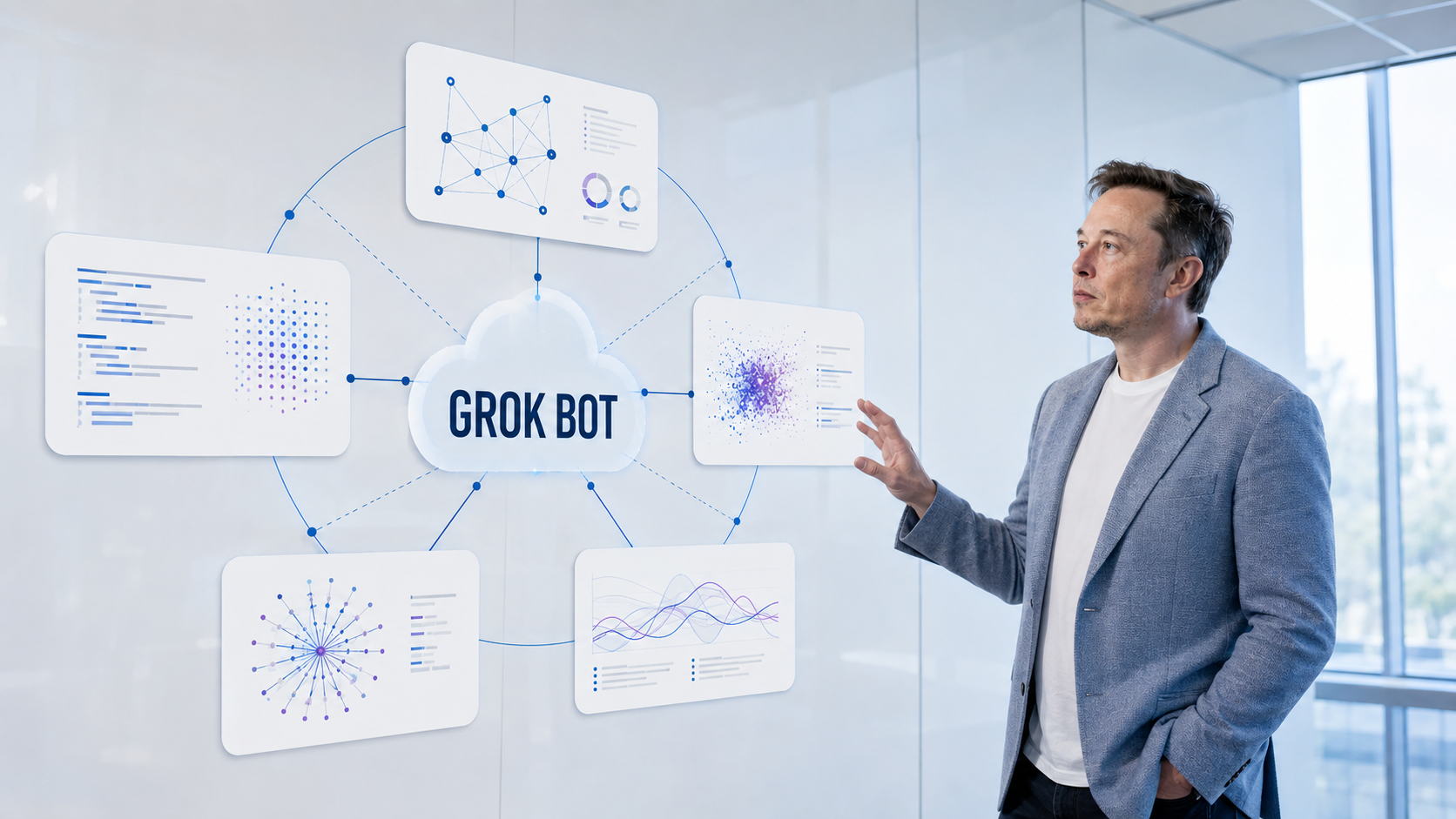
The chatbot race is turning into a race to build AI teams. Grok Bot, ChatGPT Work and Claude Cowork can all move beyond answering questions: they can use tools, work through multistep assignments and divide a larger job among specialized agents. What separates them is not whether they are “agentic.” It is the kind of working relationship each product is designed to create.
Elon Musk’s Grok Bot launched in early beta on August 11, 2026, with an unusually literal idea of an AI workforce: users create persistent, named Bots that can collaborate with one another. OpenAI’s ChatGPT Work takes a broader workbench approach, combining local and cloud execution with files, apps, tools and parallel subagents. Anthropic’s product—officially called Claude Cowork, although people sometimes shorten the name to “Claude Work”—acts more like a project operator that plans a job and coordinates its own supporting agents.
All three products are changing quickly. This comparison reflects their official documentation as of September 3, 2026, and focuses on product design rather than benchmark scores. The most useful question is not which model is universally smartest. It is which operating model fits the work.
Three products, three ideas about an AI team
The simplest way to understand the category is to ask who appears to be in charge. With Grok Bot, the user manages a visible roster. With ChatGPT Work, the user enters a flexible workspace and can delegate to a primary task, a dedicated project teammate or a set of subagents. With Claude Cowork, the user typically gives one lead agent an outcome and lets it break that outcome into parallel workstreams.
Grok Bot looks like a digital org chart. ChatGPT Work looks like a universal workbench. Claude Cowork looks like an autonomous project operator.
Those descriptions are not hard technical boundaries. Each platform can overlap with the others, and all three can produce documents, use outside services and keep a person in the approval loop. But their interfaces encourage different habits—and those habits may matter more than a small difference in model performance.
Grok Bot: the digital org chart
Grok Bot’s most distinctive feature is the Bot itself. According to xAI’s product documentation, each Bot is a persistent, named agent that can develop a role, remember preferences and work through a browser, terminal and file system. A user might create a research Bot, an operations Bot and a writing Bot, then bring them into a group thread where they can exchange context, hand off work and decide who owns the next step.
That makes multi-agent coordination visible. Instead of one assistant silently spawning temporary workers, Grok Bot presents specialists as recurring members of a team. A Bot can message another Bot directly, and one can manage several others working in parallel. The value is organizational continuity: the same specialist can return with the same mandate, working style and history instead of being recreated for every assignment.
Grok Bot also gives each user a persistent cloud computer. Browser sessions, files and authenticated tools can remain available after a conversation ends, allowing work to continue without the user’s laptop staying open. That continuity is powerful, but it carries an important security caveat. All of a user’s Bots share that computer. They may therefore share access to its files, sessions and credentials; separate Bot names are roles, not separate security boundaries.
Grok Bot’s clearest value: it productizes the relationships among agents. It is a strong fit when a person wants long-lived digital roles that communicate with one another and take recurring ownership of work. Its main challenge is governance: a useful roster needs clear permissions, approval rules and audit trails, especially when every Bot operates inside the same user-level environment. xAI’s security guidance makes those approval boundaries part of the setup rather than an afterthought.
ChatGPT Work: the general-purpose workbench
ChatGPT Work is organized around outcomes rather than a fixed roster. A task can gather information, work with files and approved apps, use a browser or terminal and create a finished artifact such as a brief, analysis, spreadsheet or presentation. The user can see the work, steer it and approve consequential steps.
Its major advantage is range. Local Work can use resources on the user’s computer, including local files and supported apps. Cloud Work runs in an isolated hosted environment and can continue after the app is closed or the computer is turned off. That gives users a practical choice: keep sensitive, context-heavy work close to the desktop, or send a bounded task to the cloud so it can keep moving in the background. Enterprise controls extend that model with managed permissions and data boundaries.
ChatGPT Work is also multi-agent. On eligible accounts, a task can delegate parts of a job to specialized subagents, run those workstreams in parallel and assemble the results. OpenAI also documents dedicated project tasks that retain the context of a workstream, monitor changes and prepare the next step while waiting for human approval.
The difference from Grok Bot is emphasis. ChatGPT Work’s subagents generally serve a parent task; the workspace is the central object. Grok makes the recurring agent identities and their conversations central. ChatGPT Work can still behave like a chief of staff or project teammate, but its strongest proposition is a broad, flexible environment for getting many kinds of work done.
ChatGPT Work’s clearest value: it combines a general-purpose work surface, local and cloud execution, parallel delegation, polished file creation and organizational controls. It is the strongest match for users who want one adaptable workspace across research, analysis, coding and business documents without committing every workflow to a standing cast of agents.
Claude Cowork: the autonomous project operator
Claude Cowork starts with a similar promise—give the system an outcome, not a sequence of clicks—but its signature is automatic decomposition. Anthropic says Cowork can break a complex assignment into smaller tasks, coordinate subagents and run independent workstreams in parallel. The user sees the plan and can redirect the work, while Claude manages much of the internal division of labor.
Cowork is especially oriented toward knowledge work that lives in files. It can create and edit formatted documents, spreadsheets and presentations, work with project instructions and memory, and use local files through the desktop app. Anthropic also supports cloud sessions that can keep running while a user is away, along with browser actions and workflows across Microsoft 365 apps.
Compared with Grok Bot, the specialist agents in Cowork are less like permanent coworkers with their own inboxes and more like a project team assembled by a lead operator. That can reduce management overhead: the user does not need to design the roster before work begins. It also makes the supporting team less durable and less socially explicit. Anthropic currently notes that Cowork sessions themselves cannot be shared, even though individual artifacts can be.
Claude Cowork’s clearest value: it turns a complicated, document-heavy assignment into a visible plan and coordinates the parallel execution behind it. It is a natural fit for deep research, reports, financial models, presentations and cross-application office work where the quality of the final artifact matters more than maintaining a visible team of named Bots.
Grok Bot vs. ChatGPT Work vs. Claude Cowork at a glance
| Dimension | Grok Bot | ChatGPT Work | Claude Cowork |
|---|---|---|---|
| Core model | A visible roster of persistent, named Bots | A flexible local-and-cloud workspace for completing tasks | A lead project operator that plans and delegates |
| Agent teamwork | Bots message one another, share context and coordinate in group threads | A parent task delegates parallel work to hosted subagents; dedicated project tasks add continuity | Claude automatically breaks work into parallel subagent assignments |
| Continuity | Durable Bot identities, preferences and a shared persistent cloud computer | Task history, project context and long-running cloud work; local mode can use desktop context | Projects, memory, local files and continuing cloud sessions |
| Best fit | Recurring roles, team handoffs and workflows that benefit from visible agent ownership | Broad daily work, mixed local and cloud tasks, and finished business or technical artifacts | Complex research and document-heavy projects that benefit from automatic planning |
| Key value | First-class relationships among long-lived agents | Breadth, execution flexibility and an integrated work environment | Low-friction decomposition and strong knowledge-work output |
| Main caveat | Bots share one user-scoped cloud computer and security boundary | Subagents usually remain workers inside a parent task, not a visible permanent roster | Subagents are mostly internal to the session, and Cowork sessions are not currently shareable |
This table is a map, not a scorecard. A company may prefer ChatGPT Work for broad employee productivity, use Claude Cowork for a demanding analysis and choose Grok Bot for an ongoing digital operations team. Model quality, integrations, security requirements, cost and existing vendor relationships will all affect the decision.
So what is Grok Bot’s real edge?
Grok Bot does not own the idea of multi-agent work. ChatGPT Work and Claude Cowork can both split a job across specialized agents. Its edge is that it makes the team itself a first-class product object. The Bots have names, continuing roles and direct communication channels. The user is invited to design an organization, not simply submit a larger task.
That could be valuable in recurring operations. A market-research Bot might feed a writing Bot every morning; a support Bot might hand a reproducible bug to an engineering Bot; an operations lead might supervise both. Over time, each role could accumulate workflow knowledge and a clearer sense of what it owns. The experience resembles managing a small digital department.
The tradeoff is coordination overhead. More agents do not automatically produce better work. They can duplicate research, pass along an incorrect assumption, overwrite one another’s changes or spend more time communicating than executing. Shared context improves speed, but shared access can increase the blast radius of a mistake. The winning systems will need disciplined handoffs, scoped permissions and a reliable record of who did what.
What comes next for agentic AI teams
The following points are Capital Park’s assessment of where the market is headed, not announced product road maps. The direction is becoming clearer even if the final interface is not.
- Prediction 1
Orchestration will become the default interface. A lead agent will translate a goal into a plan, recruit specialists, resolve conflicts and report exceptions. Users will spend less time prompting each agent and more time setting the mission. - Prediction 2
Durable roles will matter more than clever prompts. The reusable asset will be an agent’s mandate, memory, tools, permissions and evaluation history. Organizations will maintain role definitions for digital workers much as they maintain job descriptions and operating procedures today. - Prediction 3
Coordination will move from chat to shared work objects. Messages are a familiar starting point, but teams eventually need task graphs, versioned files, ownership states, dependencies and event logs. The best products will make the work legible without forcing people to read every conversation. - Prediction 4
The human role will shift from operator to governor. People will define objectives, budgets, permissions and approval thresholds, then intervene when confidence is low or consequences are high. Good systems will know when to stop, explain the decision and request the right approval. - Prediction 5
Trust infrastructure will become a competitive moat. Agent identity, least-privilege access, source provenance, action logs, evaluations and rollback will matter as much as raw model intelligence. Enterprises will favor systems they can inspect and constrain. - Prediction 6
Small, accountable teams will beat giant swarms. In most business settings, three to eight well-defined specialists with a clear manager will likely outperform dozens of loosely coordinated agents. Every additional agent adds cost, latency and another path for an error to spread. - Prediction 7
Agent systems will become more portable—and pricing will evolve. Open connection standards, reusable skills and portable agent identities should make it easier to move work across models and vendors. At the same time, pricing may shift beyond seats and tokens toward capacity, completed workflows or service levels.
The bottom line
Grok Bot, ChatGPT Work and Claude Cowork are converging on the same broad destination: AI that can coordinate work, not merely discuss it. They are taking different roads. Grok Bot makes a persistent team visible. ChatGPT Work provides a broad environment in which people and agents can work across local and cloud contexts. Claude Cowork emphasizes autonomous planning and coordinated execution for substantial projects.
For buyers, the practical choice is straightforward. Choose Grok Bot when durable digital roles and direct agent-to-agent handoffs are the main attraction. Choose ChatGPT Work when breadth, local-and-cloud flexibility and a general-purpose workbench matter most. Choose Claude Cowork when the priority is turning a complex body of files and instructions into a polished result with minimal orchestration by the user.
The long-term winner may not be the system with the largest number of Bots. It may be the one that makes a small team of agents dependable: clear in its roles, careful with authority and easy for a person to supervise.
Sources and further reading: xAI: Introducing Grok Bot, Grok Bot overview, Grok Bot approvals, security and privacy, OpenAI: Get started with ChatGPT Work, OpenAI: Subagents in ChatGPT Work, OpenAI: Project teammate, Anthropic: Get started with Claude Cowork, and Anthropic: Work across Microsoft 365 apps. Product information checked September 3, 2026.