Wall Street Is Moving Onchain: Tokenized Stocks, RWAs, and the Future of Finance
Tokenized stocks, real-world assets, and TradFi perpetuals are bringing traditional markets into crypto’s infrastructure. We see a lasting shift in how capital moves, trades, and works.

Capital Park · Singapore
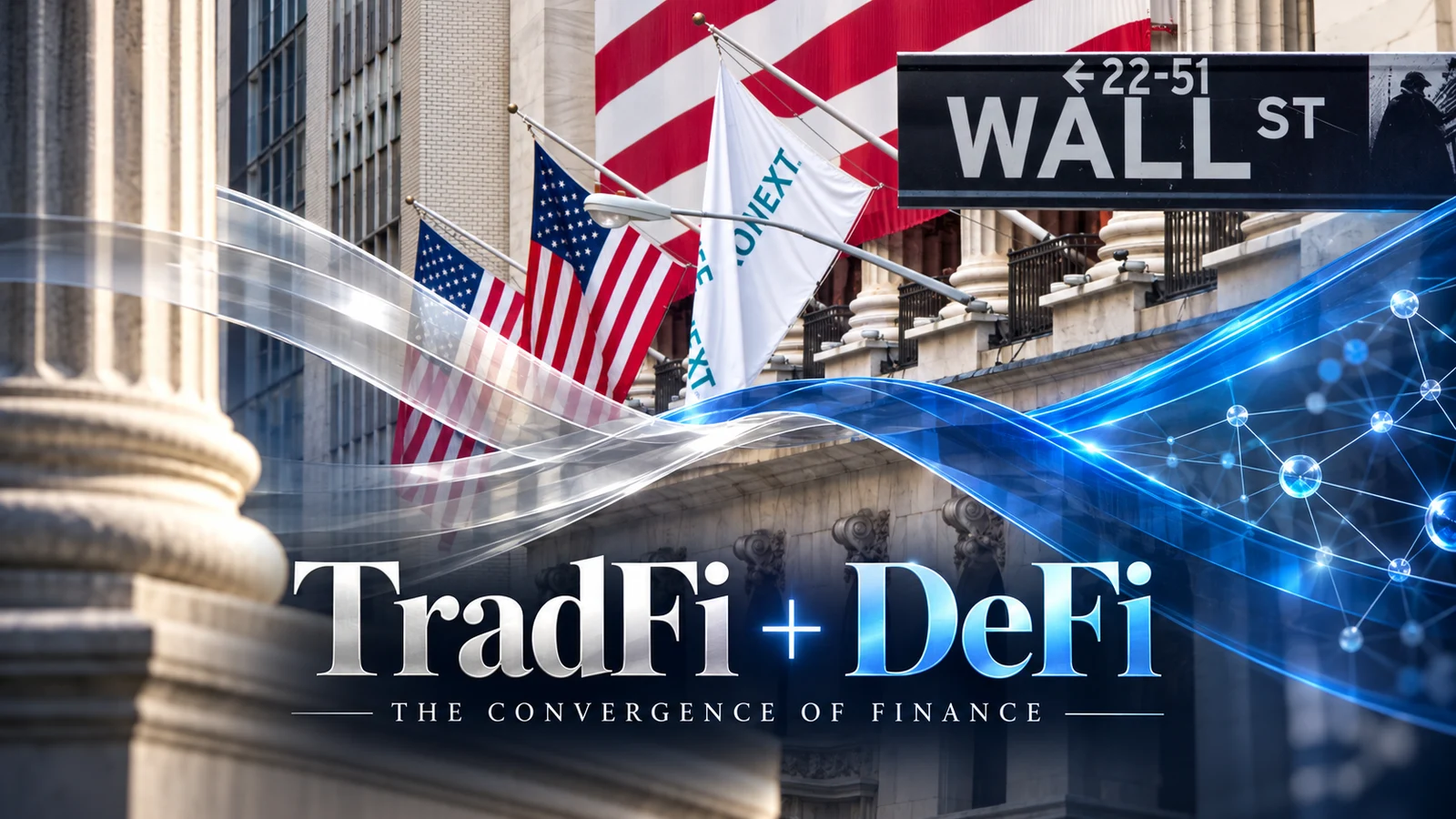
Wall Street’s next major infrastructure shift may be taking shape on blockchain networks. Stocks, government debt, investment funds, and the derivatives linked to them are increasingly meeting the trading systems built for crypto. At Capital Park, we see this convergence as one of digital finance’s most consequential long-term developments.
The investment case extends beyond another crypto narrative. Tokenization can change how assets are issued, held, transferred, and used as collateral. Perpetual futures can bring familiar financial exposures to markets that operate around the clock. Together, they create the foundations for a broader financial system in which capital moves more freely between traditional and decentralized markets.
Tokenized stocks and RWAs: one umbrella, different instruments
Tokenized stocks are part of the broader real-world asset, or RWA, category. RWA tokenization represents an asset or a claim linked to it on a blockchain. The underlying exposure might be an equity, Treasury security, fund interest, private loan, property interest, or commodity. “Real-world” includes financial assets; it does not mean only physical objects.
The legal structure matters as much as the technology. A token can represent a direct security interest, an interest in a vehicle holding assets, or a contractual claim that follows an asset’s value. Those structures can provide very different ownership, redemption, and voting rights.
| Instrument | What it represents | What to distinguish |
|---|---|---|
| Tokenized equity | A share or a claim linked to a share | Direct ownership and shareholder rights depend on the structure. |
| Other tokenized RWAs | Claims linked to funds, debt, property, or commodities | Backing, transfer eligibility, and redemption terms differ. |
| TradFi perpetuals | A derivative tracking a traditional asset’s price | Price exposure, with funding and liquidation mechanics; no ownership of the reference asset. |
Stock perpetuals belong to the wider convergence of traditional and crypto finance, but they are not tokenized shares. Binance’s product documentation explicitly distinguishes its USDT-settled contracts from ownership of the underlying securities. A centralized exchange can offer these products using an internal ledger; that trading activity is not automatically onchain.
Wall Street is already building
Institutional participation has moved beyond theoretical interest. BlackRock’s BUIDL fund, tokenized by Securitize, launched in March 2024 and expanded to Solana in March 2025 after surpassing $1 billion in assets. The Securitize announcement describes access for qualified investors, dollar yields, and near-real-time transfers between eligible holders.
J.P. Morgan Asset Management followed with MONY, a tokenized money market fund on Ethereum, announced in December 2025. The fund invests in U.S. Treasuries and Treasury-backed repurchase agreements and supports subscriptions and redemptions through its institutional platform using cash or stablecoins.
These examples reveal a practical starting point: cash management and collateral. Investors already understand the underlying assets. Blockchain infrastructure can add transferability and integration with other financial applications. Tokenization adoption therefore need not depend on investors becoming bullish on cryptocurrency prices.
The exchange infrastructure is changing, too. In January 2026, the NYSE announced development of a tokenized-securities platform designed for continuous trading, stablecoin funding, and blockchain settlement, subject to regulatory approvals. Its proposed structure preserves dividends and governance rights. That illustrates how established exchanges can adopt blockchain while retaining a regulated market structure.
Why the advantages matter
Markets can operate beyond the closing bell. Investors in Asia should not have to organize every trading decision around New York’s business day. Some onchain instruments and TradFi perpetuals support 24/7 activity. Trading hours remain product-specific, however: a token can transfer continuously while its issuer’s redemption process or underlying exchange operates on a narrower schedule.
Settlement and collateral can become more flexible. Where both the asset and payment are supported on compatible infrastructure, transactions can settle quickly and collateral can move outside banking hours. Linking the delivery of an asset to payment can also reduce settlement exposure. Those benefits depend on the actual design; a blockchain record alone does not accelerate every offchain process.
Access can become more direct. Eligible users can interact with decentralized trading protocols through a wallet, reducing dependence on a single brokerage interface or custodian. Smaller denominations can also lower entry barriers. Issuers, custodians, oracles, validators, and compliance controls still perform essential functions, and centralized exchanges remain intermediaries.
Assets can do more within a connected financial system. An eligible tokenized asset may be transferred, pledged, or used in compatible lending and trading applications. This ability to combine financial building blocks is one of DeFi’s most powerful ideas. Its value is greatest when legal rights, risk controls, and liquidity remain clear across those applications.
The opportunity is to make established financial assets more accessible, more mobile, and more useful.
TradFi perpetuals are widening crypto’s trading universe
Binance’s expansion into perpetuals linked to stocks, ETFs, and commodities shows how quickly a crypto trading platform can become a multi-asset venue. The Block reported, citing Binance, that monthly TradFi perpetual trading volume reached approximately $433.4 billion in August 2026, compared with $29.5 billion in January—roughly fifteen times the earlier level.
That is substantial activity, but it is derivatives trading volume, not $433.4 billion of new capital entering crypto. Leverage and repeated turnover can produce large notional figures from a smaller pool of collateral. The signal is growing demand to trade traditional exposures through crypto’s market infrastructure.
On the decentralized side, Hyperliquid’s HIP-3 framework allows builders to deploy and operate perpetual markets. trade[XYZ] documents markets spanning stocks, equity indexes, commodities, and currencies. This expands the scope of onchain trading beyond crypto-native assets and gives independent builders a route to serve additional financial markets.
For traders, the appeal is a common environment for multiple exposures, continuous risk management, and flexible collateral. The trade-offs include funding costs, leverage, liquidation risk, and dependence on reliable reference prices—especially when the underlying cash market is closed.
Robinhood is connecting distribution with onchain finance
Robinhood’s evolution is significant because a familiar investing interface can bring blockchain-based products to people who would never start with a standalone DeFi application. Its July 2026 announcement introduced Robinhood Chain mainnet and a new stock-token offering, alongside broader DeFi and perpetual-futures initiatives, with eligibility varying by product and jurisdiction.
The company’s stock-token documentation makes a crucial distinction: the new tokens are debt securities providing economic exposure to underlying shares or ETFs, rather than legal or beneficial ownership of those underlying securities. They should not be described as identical to holding a company’s ordinary shares.
Robinhood’s strategic importance is its ability to connect mainstream distribution with blockchain infrastructure. We believe adoption can accelerate when wallets, settlement, and financial applications become convenient features of a familiar investing experience. Access restrictions and product terms will continue to shape that rollout.
Capital Park’s view: a shared financial future
At Capital Park, we believe traditional finance and decentralized finance are moving toward a shared future. Tokenized assets, stablecoin settlement, and continuously traded derivatives are bringing the two systems closer together, creating opportunities for better access, more efficient capital use, and new investment strategies.
We remain optimistic about that convergence. As the infrastructure matures, we foresee a larger role for both CEXs and DEXs in global finance and a broader pool of capital participating in onchain markets. Building that future will take disciplined execution, but its potential extends well beyond crypto: it could reshape how financial markets operate.
Research notes. Sources are linked at the relevant claims and were reviewed on October 24, 2026. The Binance volume figures are reported by The Block from Binance data and refer to monthly notional turnover, not net inflows or assets under management. Product descriptions are based on issuer and protocol documentation. Capital Park’s expectations for adoption, capital flows, and market convergence are forward-looking views. Product eligibility and terms can change.